Youtopia's Flow
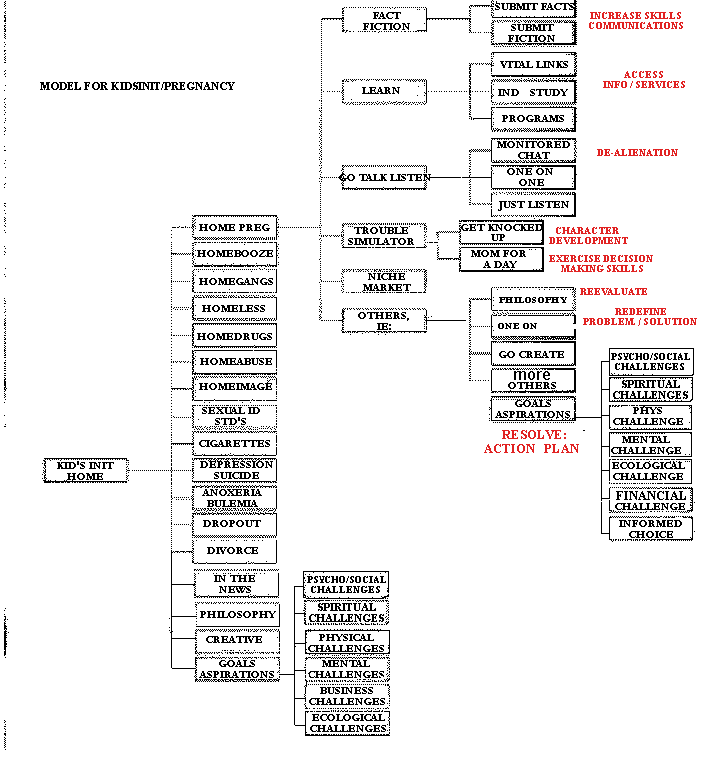
This flowchart previously existed only as an orphaned duplicate (apx4.html/2apx.html) not linked from anywhere in the site — it's now placed here, on the page its content actually maps to.
Through the curriculum, users learn computer and communication skills that facilitate their employment.
By exploring age-appropriate reference material — case studies, peer content, and material donated by teen-related nonprofits — users have the opportunity to guide their own decision-making processes.
By participating in the game, users share experiences with peers and contemplate the truth and consequences of those events.
The Game
The Game is an exploration in cause and effect. The object is to empower the player while improving their decision-making abilities. Oriented toward putting the laws of cause and effect into motion, the player makes choices: first by selecting an avatar to bring into play, à la It's a Wonderful Life, and second by seeing that the decisions made — and the moral dilemmas dealt with or ignored — ultimately affect the quality and conditions of the lives they're responsible for. Real-time data feeds and stats make each chapter's "issue" a valid event; as the game is ongoing, user input is also a factor.
The Educational Curriculum
This has been explored through prior participation with BAMTA's Digital Clubhouse and educators of the Santa Clara County Office of Education's Alternative Schools, with possible participation from the Bayside At-Risk Youth Program, the Overfelt Vertical Slice, and various universities developing Internet education and training. The focus is on project-based learning and independent studies, where teachers guide students toward their specific interests. Local mentoring programs assist with subject-oriented or career guidance.
The content — independent projects — is placed onto the relevant chapters of the site for re-evaluation by peers. All content supplied by students is protected by anonymity and reviewed before posting; levels of information dissemination may be edited or require parental approval where necessary.
The Reference Area
Content is supplied, per niche crisis, by large content corporations, publishing companies, the social service index, and government statistics. This material is placed alongside user content, enabling users to find facts specific to their area of interest, while nonprofits near and far can share their existence and content within the site's other reference areas.
This provides a "systems approach" to the thinking process. Content placed alongside the underlying database of textual information — covering biology, psychology, law, the penal system, news items, and information from the social service index and content companies — shows not only the overview of each subject, but how these elements interact with one another.
Example: the use of tobacco
A single issue like tobacco is surrounded, in the reference area, by:
- Incidence of kids smoking
- Cost of cigarette-company advertising aimed at kids
- Number of people dying of cancer
- A student's experience of losing a loved one
- An independent study of the chemical components in processed tobacco
- The history of tobacco
- Judicial cases regarding tobacco
- Tobacco companies' political influence
- Chemical additives in tobacco products
- An independent study on those additives and the body
- A peer's interview with a parent who smokes
- A peer's interview with a parent who is dying of cancer
- Advertisements regarding tobacco use
- Information from the cancer society
- Information from the asthma association
- Information on where to get help locally
- A monitored chat line, serviced by MFCC-program interns as part of their required community service hours
- Information from Smokenders and other quitting programs, plus 800 help lines
This crystallization of content lets the user see how society fuels itself, as well as why and how certain issues become prevalent within it.